You open the dishwasher and there’s an inch of dirty water sitting in the bottom. It’s an easy problem to panic about and a cheap one to fix most of the time — the majority of these calls come down to a clogged filter or a kinked hose, and you can clear both in twenty minutes with a towel and a screwdriver.
Work through this in order. The steps go cheapest and most likely first, and each one rules something out.
Before you start: turn the dishwasher off at the breaker. And bail the standing water out with a cup and a sponge before you do anything else, or you’ll be mopping the floor for the rest of the afternoon.
Tools You’ll Want
Nothing exotic. Most of this is a screwdriver and patience.
- Phillips and flat screwdrivers
- A shop vac or wet vac, which makes clearing the sump enormously easier
- A stiff bottle brush or an old toothbrush
- A bucket and towels
- Needle-nose pliers
Of that list, the one genuinely worth owning if you don’t already is a wet/dry shop vac — sucking the sump dry in ten seconds turns the worst part of this job into the easiest, and it pays for itself the first time a water heater or a washer lets go. A cheap set of appliance brushes helps too, though an old toothbrush does most of what they do.
If it turns out you need a part, you’ll want the model number first. It’s on a sticker along the edge of the door, visible when the door is open — usually the top or left side of the tub opening.
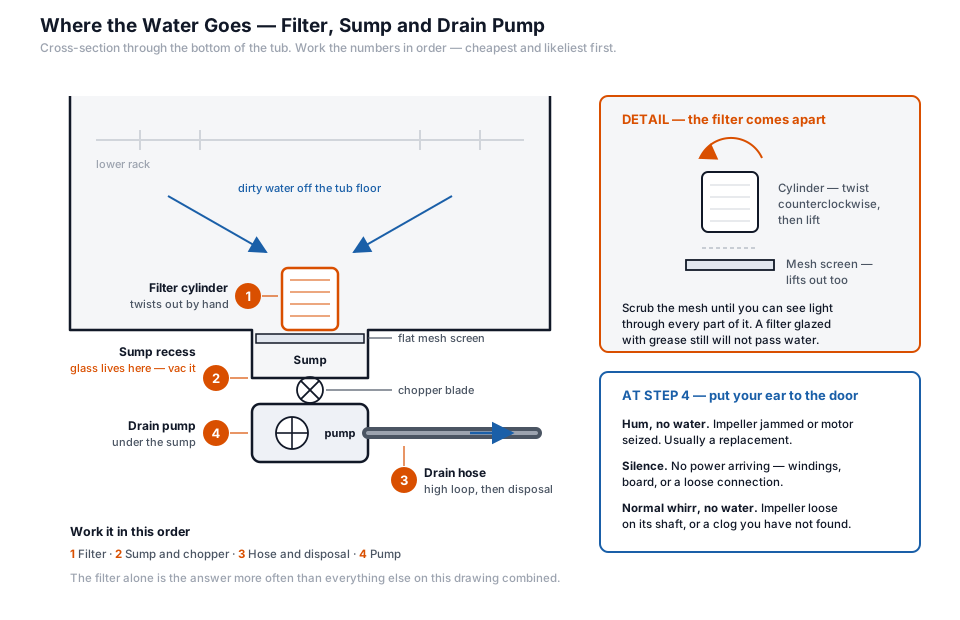
Step 1: Clean the Filter
On most dishwashers made in the last fifteen years, this is the answer more often than everything else combined.
Pull the bottom rack out. In the floor of the tub you’ll find a cylindrical filter, usually with an arrow and a lock icon on top. Twist it counterclockwise and lift it out. Underneath there’s a flat mesh screen that also lifts out on most models.
What you find under there is frequently disgusting — a compacted mat of grease, labels off jars, seeds, and bits of broken glass. Rinse both parts under hot water and scrub the mesh with a brush until you can see light through every part of it. A filter that looks clean but is glazed over with grease still won’t pass water.
Reassemble, run a cycle, and see if it drains. If it does, you’re done, and you should be cleaning that filter every month or two.
Step 2: Clear the Sump and Check for Glass
With the filter out, look down into the sump — the recess where the filter sat. Reach in carefully with your fingers or the shop vac hose.
Go slow here. Broken glass in the sump is common and it’s sharp. If you know you’ve broken a glass in the dishwasher recently, use the vac rather than your hands.
You’re looking for anything that could block the intake to the drain pump: a fruit sticker, a chunk of bone, a bottle cap, a piece of a dish. Vacuum the sump dry and clear.
While you’re in there, check the chopper blade if your model has one. It’s a small impeller near the sump intake that grinds food fine enough to pass. If it’s jammed with debris or the blade is broken, food gets through to the pump and clogs it.
Step 3: Check the Drain Hose and the Garbage Disposal
If the filter and sump are clean and it still won’t drain, the blockage is downstream.
Start with the disposal, because this one catches people constantly. If your dishwasher drains into a garbage disposal, and that disposal was installed recently, there’s a knockout plug inside the disposal’s dishwasher inlet that has to be punched out at installation. If a plumber or a homeowner missed it, the dishwasher will never drain. Not once, not ever. Look up the disposal inlet with a flashlight — if you see a solid plastic disc, that’s the problem.
Run the disposal for thirty seconds regardless. A disposal packed with food waste will back water up into the dishwasher.
Then check the hose. Under the sink, find the corrugated hose running from the dishwasher to the disposal or the drain standpipe. Squeeze along its length feeling for a hard lump — that’s a clog. Look for kinks, especially where the hose passes through the cabinet wall.
Put the bucket underneath, pull the hose off at the disposal end with pliers, and see whether water runs out. If water pours out, the clog is downstream of that point. If nothing comes out, the clog is between there and the dishwasher.
Check the high loop. The drain hose is supposed to rise up and attach high under the counter before dropping to the disposal. That loop is what stops dirty sink water from siphoning back into the dishwasher. If the hose runs flat along the cabinet floor, that’s both a drainage problem and a sanitation one. Strap it up under the countertop. If the hose itself is kinked, crushed where the machine was pushed back against it, or brittle enough that straightening it cracks the ribbing, replace it — a drain hose kit comes with the clamps you’ll need and costs less than the callout fee to have someone tell you the hose is kinked.
Step 4: Test the Drain Pump
If everything upstream is clear, you’re down to the pump or the control board.
Start the dishwasher and put your ear against the lower front panel during the drain portion of the cycle. You’re listening for one of three things:
A hum with no water movement. The pump is getting power and trying to run, but the impeller is jammed or the motor is seized. Usually means replacement.
Silence. No power reaching the pump. Could be the pump’s windings are open, could be the control board, could be a wiring connection. Test the pump’s resistance with a multimeter — an open circuit means the pump is dead.
A normal whirring sound with no drainage. The impeller is spinning but not moving water, which usually means it’s broken off its shaft, or there’s still a blockage you haven’t found.
To reach the pump, pull the dishwasher out and lay it on its back — most drain pumps mount on the underside of the sump. Some models let you get at it from inside the tub after removing the sump housing.
Replacement Pumps by Brand
Find your model number before ordering. Dishwasher pumps are not interchangeable across brands, and often not across model years within a brand.
On the Whirlpool platform — which also covers KitchenAid, Maytag and Amana — part W10348269 covers a large number of units, and that pump number is the one to search on if your machine came out of that family. Frigidaire and Electrolux machines most often take 154730301, and searching that number will usually land you on the right assembly first time. On GE, WD26X10013 fits a wide span of models, though GE changed sump designs partway through the 2010s, so this is one where the model check matters more than usual.
Bosch is the outlier: its drain pumps vary by series rather than by era, so there’s no single number worth memorizing and you’ll want to search with your full model number instead. The same goes for Samsung and LG — both use model-specific pumps, so pull the number off the door sticker and match it before you buy either a Samsung or an LG replacement.
Before you buy anything, verify the part number against your own model.
The numbers above cover the most common units, but they are not universal, and manufacturers change parts mid-model-year without changing the model name. Punch your full model number into searspartsdirect.com and confirm the part it returns matches what you're about to order. It takes about a minute, it's free, and it's the difference between one delivery and two.
Your model number is on a sticker along the door edge, on the tub rim, or on the side of the door itself — not on the front panel.
Swapping the pump is a genuinely doable repair — disconnect power and water, pull the unit, unclip the old pump, transfer the wiring harness, clip the new one in. Budget an hour if it’s your first time.
Keeping It From Happening Again
Scrape plates, don’t rinse them. Modern detergent needs some food residue to work against, but it can’t handle a chicken bone.
Clean the filter monthly. It takes two minutes and it prevents most of what’s in this article.
Run the hot tap at the sink before starting a cycle, so the dishwasher fills with hot water immediately rather than pushing a slug of cold through first.
Run the disposal before the dishwasher, every time.
And once in a while, run an empty cycle with a cup of white vinegar on the top rack to cut the grease film that builds up in the sump and hoses.
Bottom Line
Nine times out of ten this is the filter or something lodged in the sump, and it costs you nothing but twenty minutes. Check those first, then the disposal knockout plug and the drain hose, and only then start thinking about the pump.
Keep Reading
- Dishwasher won’t drain after a new garbage disposal — if the timing lines up with a disposal swap, it’s almost certainly the knockout plug, and it’s a ten-minute fix
- Washer not draining? Here’s how to fix it — same failure logic, different machine
- Where to buy appliance parts without getting burned — matching a pump to your model number
Common Questions
Why is there water in the bottom of my dishwasher after every cycle?
A small amount of water in the sump is normal by design — it keeps the seals from drying out. If it's more than a cup, or it's dirty, that's a drainage problem.
Can I just pour drain cleaner in it?
No. Chemical drain cleaners damage the pump seals and the rubber hoses, and they'll sit in the sump rather than flowing through. If you have a clog, clear it mechanically.
My dishwasher drains but very slowly. Same problem?
Same causes, earlier stage. Usually a partially clogged filter or a partially blocked hose. Clean it now before it becomes a full blockage.
How much does a professional drain pump replacement cost?
Typically $180 to $350 installed depending on brand and how hard the unit is to pull out. If the fix turns out to be the filter, any honest tech will tell you so.
Is it worth repairing an old dishwasher?
Under eight years, generally yes — a pump is a cheap repair against a $700 replacement. Past twelve years, with multiple things going wrong, less so.